

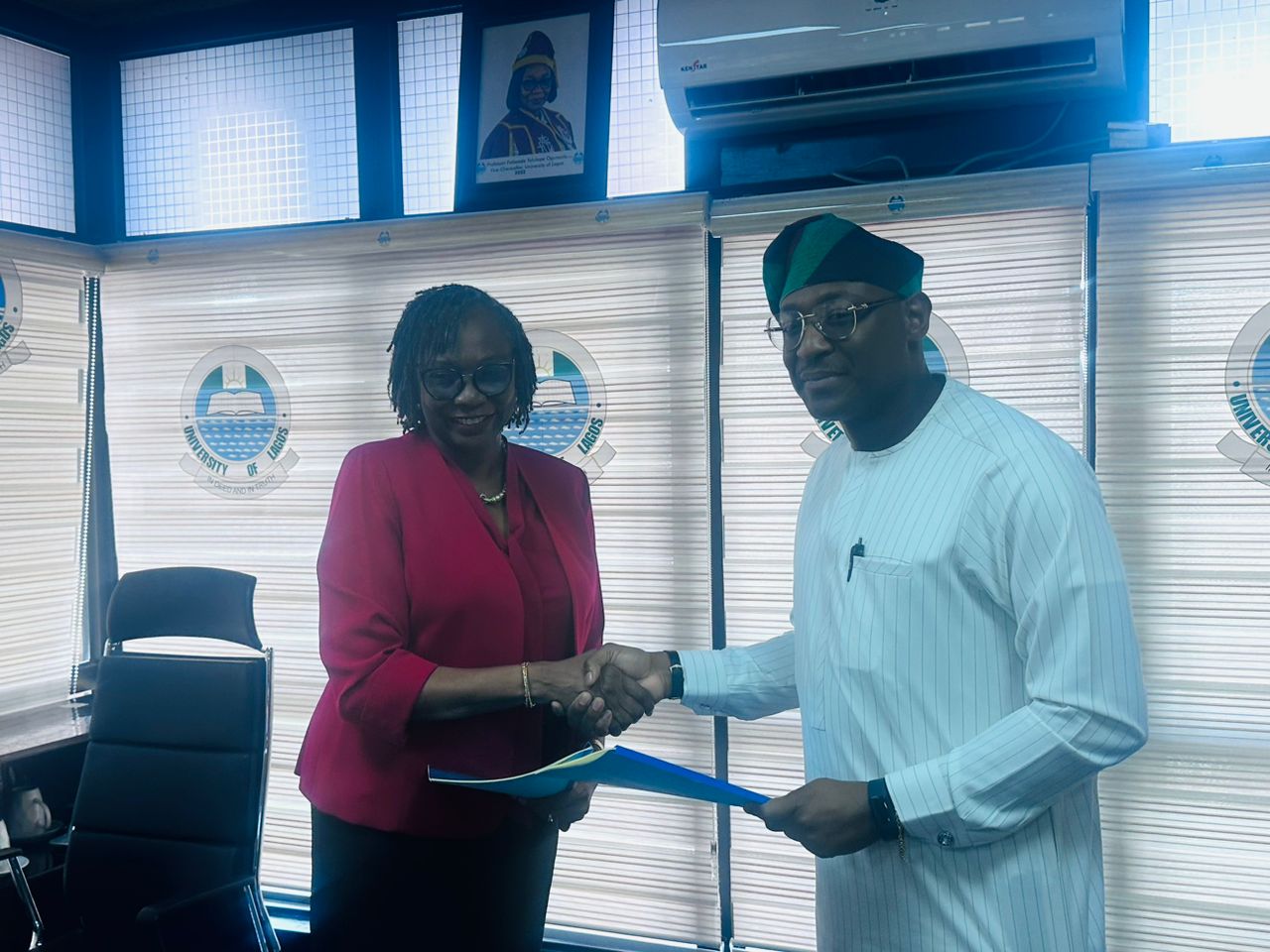
The Nigerian Safety Investigation Bureau (NSIB) has renewed its Memorandum of Understanding (MoU) with the University of Lagos (UNILAG) for the deployment of its metallurgical science laboratory at the Nnamdi Azikiwe International Airport (NAIA), Abuja. This agreement, originally signed in July 2018 under the former leadership of the bureau when it was still known as the Accident Investigation Bureau (AIB), was renewed by NSIB Director-General, Captain Alex Badeh Jr., and UNILAG Vice-Chancellor, Professor Folasade Ogunsola.
The initial MoU aimed at relocating some of the equipment from the laboratory to UNILAG to enhance collaboration and scientific research. However, due to logistical issues, the equipment transfer was delayed. The current leadership of the NSIB has now taken steps to reactivate the agreement and fast-track the process.
At the MoU signing ceremony held at the UNILAG Senate Building, Captain Badeh emphasized the importance of the collaboration and stated that the bureau is committed to accelerating the relocation of some of the equipment for immediate use by the university. He explained that the initial agreement stalled due to logistics and political challenges, but upon his assumption of office, he prioritized its renewal.
In his words, “Well, the initial one was signed in 2018, like you said. And between then and now, I know there have been subsequent meetings between UNILAG and the NSIB, but there was no real follow-through for whatever reasons, you know, logistics or political reasons. And when I took over, I met the MoU there needing a renewal, and I saw the lack of movement with the last MOU. So we discussed internally. We need University of Lagos expertise and other academia in Nigeria with the NSIB. But we have some equipment that we can’t use at present.”

Captain Badeh further explained that the collaboration with UNILAG is crucial because the NSIB has high-end equipment that remains underutilized due to lack of expertise, which the university can provide. “We just thought collaboration is the way to go. There’s no reason why these things are sitting there and you have a capable hand at universities all across. So we went back to the University of Lagos, which we’re starting with,” he added.
He disclosed that, within two weeks, a team of UNILAG professors from the metallurgical department will visit Abuja to reassess the equipment and update their evaluations, noting that science evolves, and technologies from four or five years ago might now require updates. According to him, “This is the first step in that direction. Once they visit and they give us their needs and we share, exchange our ideas, we’ll take it forward to our superiors and try to move forward with this collaboration.”
Captain Badeh also revealed that the bureau often has to send engine parts abroad for analysis following aviation incidents, a costly and time-consuming process. “Even to test our engines… when we have a crash or an accident, we have to send them abroad. We’re just in the process of sending something to Kenya that’s in Africa,” he stated, underscoring the need to develop local capacity through such collaborations.
Earlier in her remarks, Professor Folasade Ogunsola, Vice-Chancellor of UNILAG, highlighted the mutual benefits of the collaboration. She noted that the equipment would significantly boost the university’s teaching and research capabilities, particularly in metallurgy and related fields. According to her, the university is committed to using demand-driven research to propel Nigeria’s development.

“We are intentional to make sure our research is demand-driven. We want to move Nigeria forward as a university, and we want you to challenge us to come up with solutions,” she said. Professor Ogunsola emphasized that the collaboration would not only benefit the university but also support the NSIB and enhance the manpower needed to support Nigeria’s future development. “We have the capacity, but we need support to leverage on the capacity,” she added.
Professor Samson Adeosun, Dean of the Faculty of Engineering at UNILAG, also urged the NSIB to expedite the relocation of the equipment. He expressed the university’s anticipation that the equipment would be transferred immediately after the initial agreement was signed and stressed that it would play a critical role in advancing the university’s research capacity.
“There is a lot of skill that can be deployed into that collaboration once we move the equipment,” Professor Adeosun said, adding that the university currently sends samples from Lagos to Kaduna for analysis, a situation that would no longer be necessary once the equipment is moved. “The aviation industry will benefit. The nation will benefit, and it will increase the rating of the laboratory,” he noted.
The renewed MoU is expected to foster a stronger partnership between NSIB and UNILAG, facilitating local expertise and bolstering Nigeria’s aviation safety and investigative capabilities. It marks a significant step toward reducing reliance on foreign laboratories for critical metallurgical analysis and investigations.

L-R, Joining the NSIB DG was the Director, Legal Services/Company Secretary, Esosa Eremwanarue and other staff in the legal department. While the VC was joined by the Acting Registrar, Mrs. Olakunle Makinde; Deputy Vice-Chancellors Management Services and Academic, as well as Director of Academic Planning, among others.


